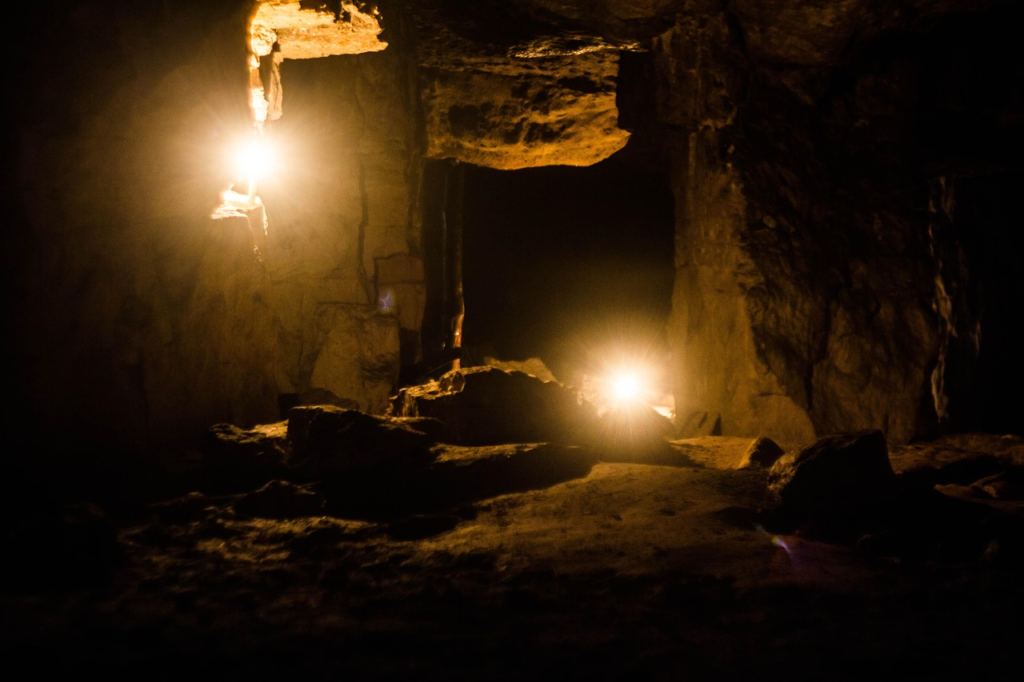
We live in caves. We have no fear of the light. We have a love of the outside, and the sunshine, and the moonlight, and sun-baked wheat to make good whiskey.
That is what we love. Not what we need.
What we need are the things we find beneath the Earth; the things we learn from the Caves; the experience of relying brother-to-brother, even if you hate whoever is by your side, because you’re in a place where a slip or mis-action is death, and all human grudges suddenly seem of no importance at all for a while. They come back…but always changed.
What we find. What we learn. What we make when we synthesize the two. What we understand and learn and do over a hundred, two hundred, three hundred years in a devoted Dwarf’s life.
A Dwarven philosophy of warfare: Don’t. It cuts into your mining time.
This is a free book.
Some pieces of this book have appeared, usually in a slightly different form, on JeffMachWrites or in what Jeff keeps calling “The Dwarf Dark Lord Book”. I didn’t think you’ll mind.
Contents
- Dwarven Halls
- Three Rules All Dwarves Live By
- The Law Of The Hammer
- Pickup Lines For Dwarves
- On Dwarven Combat & Governance
- Tales Of Dwarvish Wisdom
- Three Classic Dwarf Zen Stories
- Three Dwarven Poems
- The Under-Sea
- Rocks Fall, Everybody Dies: A Short Poem About A War With Dwarves
- The Dwarf and the Pyrite
- A Dwarf’s View of Goblins
- Three Dwarves Determine The Proper Amount Of Ice To Put Into Your Whiskey
- From The Time The Dwarves (Briefly) Served Loki
- How The Gods Take Credit: Another Dwarven Tale Of P’tah And Others
- The Dwarven Ambassador Fails With Dragons
- The Dwarf Ambassador and the Ogress
- The Dwarvish Ambassador and the Dryads of Pan
- The Dark Lord, The Dwarf, And The Dragon
- Dwarves Revolution
- Splitting The Prince: A Piece Of Dwarven History
- From Rock and Stone
- A Proclamation
- Dwarven Construction Note
- The Three Dwarven Braggarts
- Building A Better Government
- The Loudest Dwarf
Dwarven Halls
This first appeared as Dwarven Halls.
In halls of stone, in halls of stone,
Our picks our quills, the Mine our tome,
With our own work, we build our World,
From rock and stone, we build our home.
In halls of stone, through layered rock,
We live whole lives needing no Sun
There’s gold which gleams, and fire of forge
The light of Day? No, we need none.
They say we Dwarves from surface came
For so we must, for so we must
They say we Dwarves the Sun disdained
And in its shine, we did not trust.
But know this well, but know this well,
And in your mind this knowledge lock:
We from no surface came; we’re from instead
Stone and rock, stone and rock.
From the Stone, we take our strength
For the Stone endures
You can carve it and shape it,
But the Stone is never yours.
From the Rock, we take our hearts,
Steady and strong, and yet as well
Dig down deep, to deepest rock
And strange things indeed do deep down dwell.
Through deep rock, we tunnel well
And there is meaning to our moil
Our lives we carve, as well as rock,
With the spirit of our toil.
In halls of stone, in halls of stone,
We build the World we make our own.
___________________
Three Rules All Dwarves Live By
This first appeared as Three Rules All Dwarves Live By.
ONCE, a council of seven Dwarven sages met and sat for seven long days and swore seven long oaths that they would come out with wisdom for all Dwarves.
After much discussion, it was decided that they begin with the Three Rules All Dwarves Live By.
- “There are no three rules,” said Bobkin.
- “Yes there are!,” replied Gage heatedly. “Hard work! Crafting! Quality crafting, mind. None of that newfangled trash.”
- “I actually also agree that there are no three rules,” Sterling began, “But quality crafting is important and qualifies for another discussion.
- “The title is already inaccurate,” said Bobkin frustratedly.
- “So what?” said Cole. “Are you afraid of looking stupid? We’ll all look stupid. We’ll share the blame. Like Dwarves. Hey, that’s a great Dwarven value and—”
- “…why are you all staring at me like that?”
- “I mean,” Rowen tried, speaking up slowly, “it’s not bad. It’s not awful. But not every burden is collective. I have a hammer anyone can touch and I have a hammer that only I touch and I don’t like others to touch it. Same with work. Some things we do together, some things, you can only really be a Dwarf if you do them alone.”
- “Oh, that’s good,” someone said.
- “Really good,” someone else said.
- “But obvious. And not all that helpful,” prompted Bobkin.
- “Right. Right. Right,: said Rowan.”
- “We should rename this,” said Gage.
- “Nah,” said Bobkin. “We’ll give future generations the pleasure of figuring out what we did wrong. They can learn from our example.
- We never did.
The Law Of The Hammer
This first appeared as The Law Of The Hammer.
I. Two Important Notes On Codices:
- There are people who do not have vast stone tablets y-graven with the rules and laws, divisions and jointlings, commentaries and underspeaches, additional rules, thoughts on the rules, rules on the thoughts on the rules and thoughts on the rules on the rules.
- These people are not Dwarves.
II. More On Hammers
Durbor said, “This is the Law of the Hammer:”
“First, know the place. Then, know the strike. Then, know the follow-through.”
Jacko said: “No. This is the Law of the Hammer:
“Break and join are both part of the same whole. Don’t be afraid to shatter if you have the confidence to build.”
Mujo said nothing. While the others had been speaking, he had been carving a little figure, standing erect, crude, but distinguishable, out of a piece of basalt.
“This,” he said, placing it upon the ground, “is the Law of the Hammer.”
Durbor looked at it. He looked a long time.
“Sloppy arris on that helm, he said. “That’s going to slice somebody, you don’t edge that down a bit.”
Pickup Lines For Dwarves
This first appeared as Pickup Lines For Dwarves and Pickup Lines For Dwarves: The Revenge.
How do Dwarves hit on each other (other than ‘with large hammers’?) We hoped you’d ask.
Dwarven pickup lines? Do you have ANY idea how many Dwarven bars we had to sit around in order to get these? It was probably worth the hangover, except every time we laugh, our heads fall off.
- “If our mine were to collapse, and I was able to save most of the gold, I would definitely go back for you second.”
- “The only treasures in this world finer than you are currently being sat upon by Dragons, which would definitely be a waste.”
- “I have brought thee a flagon of beer the size of thy head. I apologize for the meagerness of my offering, but this bar has terrible priorities.”
- “You are like finding the motherlode in a tectonic cave after being stuck there for two weeks: I’m really excited, but I’m also starving to death. Might you still be here in three days when I get back?”
- “I would face a Balrog for you. I would then be dead and you would have my wealth. Will you marry me?”
- “If I told you that you had a beautiful axe, would you attempt to split my helmet with it?”
- “Would you like to go mine delving? I swear this is not a metaphor. I know an excellent mine.”
On Dwarven Combat & Governance
This first appeared as On Dwarven Combat & Governance.
I.
Dwarven battle philosophy in Sam’s era looks something like this:
- We live in caves.
- You don’t.
Although it could also be expressed as:
- We live in caves that we have mined ourselves. It’s very difficult to get an attacking army OUT, even though we’ve mined and tunneled and designed these caves ourselves and have made it as easy as possible in case we want to do that.
- It’s really, really hard to get an invading army IN, especially since we’ve mined and tunneled and designed these caves ourselves and have made it as difficult as possible in case someone would want to do that.
II.
That being said, when the Dark Lord’s absolutely unbelievably vast and implacable army was about three days out, Supreme Commander Sam finally finished hiking and waving a very, very, very large white flag.
As the Dark Lord had very sensible scouts, it did not take long before Sam was standing in front of an assemblage of the Dark Lord’s generals, one of whom (Sam would learn her name later, and promptly forget it) was reading the document Sam had brought:
“This is just a genealogy of the Dwarves who wrote it,” she said.
“Yes, that’s the first two pages,” Sam agreed. “We didn’t want you to think that we lacked the authority to treat with you.”
“Where’s yours? You’re the one I’m meeting.”
“Oh, I’m nobody important,” Sam said offhandedly. “That’s why I’m Ambassadoring. Someone has to.”
The General did not blink. Much.
Sam gently walked over, took the huge sheaf of parchment from her, and started going through it. “Try around….” He moved his finger gently over the lines. “…here.”
The General (her name was Ash; she didn’t go by “General Ash” if she could help it) read out loud:
“Be it hereby noted:
“We, the Nior, acknowledge only the supreme rulership of P’tah, God of Creation and/or Miniatures.
“However, as He hasn’t been too specific with what He wants, as long as we can keep making things and generally living our lives, we will also make them on behalf of Whoever is currently running this city/country/continent/planet.
“If that’s acceptable, we’re in.”
Ash raised a very hairy eyebrow. “If that’s acceptable?” she said. A tone of voice is absolutely not capable of penetrating a tent wall in a way which is helpful to the visual spectrum, but she somehow managed to indicate the thousands and thousands and thousands of Orcs at her command without actually pointing to them.
Sam nodded. “First, while being a Ruler is better than being an Ambassador, it’s not great. You seldom get a chance to make anything really interesting, and usually if you try, other Dwarves are too busy to listen all that carefully.
“So if you have a specialist who wants to do the work, and it won’t mess with our lives too much, that sounds good to us.
“Also, militarily, we don’t really care how many Orcs die, no offense, and we’re quite fond of Dwarves. Not individually; individually, most of us can take us or leave us. But as a whole, we don’t want the chance of being wiped out.”
An entirely different General, who was not from a species that believed in names, said, “Don’t you mean ‘certainty of being wiped out?’”
So Sam spoke for a bit.
First, he reiterated the surrender of the Dwarves. No reason to let that get overlooked just because you had something interesting to talk about.
Then he began to talk about the Dwarfish part of the Underdark, and its assorted protections.
He used the words ‘cave in’, ‘mine shaft’, and ‘trapped forever in a stony darkness which has never known and will never know the Sun’ with at least relative constraint, under the circumstances.
The assembled Generals listened with increasing unease.
“So an extremely large army could take you, probably, but only by suffering massive losses and destroying large parts of what would be valuable about conquering you by force?”
“Oh, yes,” Sam said brightly.
“But you wish to surrender?”
Sam shrugged, “As a people, if you want to do all the boring work of ruling, go right ahead. If you could probably kill us a lot, that’s even more incentive.”
Then he gave a very small Sam smile.
“Also, all of our traps are generations old. We know they work. It’s not exactly interesting or skilled labor. But Ambassadoring?”
He outright grinned. “Nobody wants to do it, but at least we haven’t tried it before. If nothing else, it should be interesting.”
III.
That would be a good place for this piece of Sam’s story to end.
Interesting, yes. Well-crafted, likely not. (We judge not our own words; just the workmanship of Sam’s tale.)
There’s a great deal of honor in creating a new art form, although one’s motives aren’t generally honor (fame, perhaps. Insanity. Honor? New art forms are best made by breaking through convention in one great driven burst or set of bursts. Honor, like the House of Orange—maintains.)
It’s normal for this to be extremely honorable, once the new art form is recognized. This usually involves people going from being shocked to excited. This usually happens no more than a decade or two, or sometimes a century or three, after the innovator’s death.
Thus it goes.
Sam’s plan is to do the Ambassador job well. But there isn’t much chance he can do it artfully, or craftily. There is little chance he can do something meaningful with it, unless, say, it’s a meaningful job. But it’s politics; how meaningful can it be?
Sam is determined to do a good job, but it’s hopeless. Aside from the fact that the Dark Lord is evil, which ought to be at least impractical, there’s just the fat that nobody has really invented a great longterm system for politicking with any real success.
(For example, the less said of Dwarven experiments with both Democracy and Autocracy, the better. As for their experiment with Demonocracy, there is a reason why there are essentially no Dwarven magicians, sorcerers, or summoners.
Not anymore, anyway.)
IV.
This is what Dwarves have figured out about Government:
- Most Governmental systems are bad.
- Kings are exceptionally good or exceptionally bad and somewhat even out, and…
- …if you have Kings and Royalty, you can likely bribe them into making their families take the jobs when they retire, die, or decide to do something actually fun.
- So that’s what Dwarves do.
- It is not true that they breed their rulers to be useless.
- They simply recognize that most rulers are ALREADY useless, and breed for an inability to be too bored and a certain sense of shame if you don’t show up for work once in a while.
- This system works badly, which is to say, better than most other systems of government in use anywhere at all.
V.
A Dwarven philosophy of warfare:
Don’t. It cuts into your mining time.
A Dwarven philosophy of governance:
It is entirely possible for Government to craft something well, and not even necessarily by accident.
It is also possible for all of the atoms of a door to translocate simultaneously such that you can walk through it without opening it.
Many things are possible.
Few things are likely.
Tales Of Dwarvish Wisdom
This first appeared as Tales Of Dwarvish Wisdom.
“So,” the Wise Man said, “The Pirate proclaimed, ‘Aaaaaaarrrgh! I cannot help it! I hate the sea! I fear it! Yet I must go near it to earn my trade!’
“Now tell me,” continued the Wise Man, “what the sage replied.”
“Boats are quite valuable. Sell your boat and get a job on land, you idiot.”
The Wise Man nodded. “Very good,” he said, and gave the young man a cookie.
** **
What is the sound of one hand clapping? No idea. It ain’t the sound of someone hitting rock with hammer, I’ll tell ya that. Tell whoever it is to stop overthinking and get back to work!
** **
Either Dwarves can fly, or this is VERY good absinthe.
** **
In Wine is Truth. In sufficient amounts of Beer are gigantic Dwarven construction projects which they only sometimes regret in the morning.
** ***
Three Classic Dwarf Zen Stories
This first appeared as Three Classic Dwarf Zen Stories.
Someone with multidimensional access, which is seriously far less rare or complicated than it sounds (you’re in this book Universe right now AND, presumably, at least one other Universe, right?) ….thought it wise to introduce classic Zen stories to see if any of them would experience classic satori.
- Once there were three very young students who were left in a room and told not to speak.After several hours, one of them said, “This really sucks.” The other two Dwarves looked at him and nodded. Then they shrugged too. Then everything was silent for a few hours. Eventually, the Sensei came into the room, and the student who had spoken admitted what he had said. The other two nodded and shrugged. “Well, you failed so you could say what everybody was definitely thinking, which probably helped them get through. That’s one loss instead of three. Good job.” The other two students patted him on the back and bought him a beer (each).
- Once there were two monks, were celibate and avoided women. (This concept took over two weeks to translate into Dwarvish. Why would you work so hard becoming a priest if it wasn’t gonna make you a Lothario?)….but it was real for some reason, and these two monks, walking through a forest path, came upon a huge puddle of mud. The woman was wearing clothing of incredible artistry, and, sensibly, didn’t want to risk an inch of damage to such a thing. So the two monks cut down some trees and built her a bridge. Lots of very sensible people. Quite admirable.
- Another very young Dwarf was especially wise even as a child. One day, he accidentally broke his Master’s precious tea set.He changed his name, hair color, height, continent of residence, profession, and took a thousand precautions, which is why he lived another three and a half months.
Three Dwarven Poems
This first appeared as Three Dwarven Poems.
The Dwarven King in no Palace lives,
Has no soft bed for sleep.
The Dwarven King in no Fortress lives,
No stony cliff’s-edge Keep.
The Dwarven King lives in a hole,
Of naught but simple stone
Sometimes with a thousand attendants,
Sometimes all alone.
Forging, forging, forging, forging,
From the fruits of their excavation
Building the Castle best of all:
The joy of smelting Creation.
__
Dragon, Dragon, Treasure-keeper,
Whence thy treasure gleaming?
“Taken from the Dwarves, from burning Dwarves,
From Dwarves whose homes are steaming.
“They took it all from Mother Earth,
And were of that sin too proud.
Now the treasure’s blessed in fire and blood,
And a cleansing ember shroud.”
“Dwarven King, Dwarven King
Born to hammer’s sound
Ten generations spent
Strictly underground.”
“Yet here you pour out of your mines;
What strange times are these?”
“Ten generations matter naught;
We have long memories.”
“For all we’ve pulled from deepening Earth,
Naught has cured the stain
Our best treasure’s on the other side
Of soon-wrought Dragon’sbane.”
There from the Dragon’s aerie,
Vast opening in stone
There’s not a puff of smoke at all.
The Dragon’s dead, blood and bone.
__
There once was a Dwarf whose sharp axes
Were in keeping with old Dwarven praxis
Each iteration
Meant Orc decapitation
(That’s what the purpose of Dwarven attacks is.)
__
The Dwarf-King and the Elven King
A game of poker played
And millennia of resentment
Had little chance to fade.
For the Dwarf-King cheated just a bit
Only to sadly find
The Elf-King cheated twice
By reading his whole mind.
So over cards they came to blows,
Long before the coming of Men
The Elves won’t soon forgive the Dwarves
For winning Lothlórien.
The Under-Sea
This first appeared as The Under-Sea.
In lands above, we Dwarves do well
With sweat and labor of our hands
Our need for gold we often quell
With restless travel thorough the lands.
Yet in this we troubled
And for this, some sometimes mock
We’ll travel distances twice doubled
To avoid the merest loch
Say uplandlings, “What’s the matter?
Are you all afraid to bathe?
Or worried your clothes would scatter
From the ill weave of their lathe?”
And laugh, we laugh it off, sure.
What sane thing other to do?
Better, better keep their minds pure
Of the Sea of Durrinù.
The Sea, the Sea the Sea the Sea,
The Sea, color of fear
The water is pure,
But all is shadow as you draw near
A sea of ink, a sea of ink
A sea of ink, you’re sure
As if the spasmic splash and dying sink
Of some Kraken impure.
Yet:
Dip your hand inside the water,
(If your hand you somewise hate
In the poisedly clear water
Born of dark tectonic plate
It’s cold. Bring up a handful
Of water; so clear, so dip
And understand, full
(If no fish your hand doth clip)
The water’s pure, so the dark
The dark you sea
Is the darkness the darkness
Of the deep underground Sea.
For ’twas the Dwarves who found it,
Who found the sea of Durrinù.
(And may the Dark confound it,
For that’s all we can do:)
(A dark as Dark, a Darkling Dark,
An ebon alter slab
Pure shadow is simple and stark,
Blackness as sharp as a stab.
The Sea is endlessly strange,
And what dwells far within
Out of mind’s farthest range,
In the vortex’s howling din
What lives in the waters far below,
What in the waters dies,
Is something Dwarves almost know
And their Shamans fear and despise.
And this is why, when surface-drawn
Dwarves will be near no lake or stream,
When surface light becomes dawn,
No matter how safe the water might seem,
All Dwarven kin these waters shun
And from bottles bathe or drink
Though surface waters won’t hurt them
Their thoughts might slowly sink…
Rocks Fall, Everybody Dies: A Short Poem About A War With Dwarves
This first appeared as Rocks Fall, Everybody Dies: A Short Poem About A War With Dwarves.
So this would be a spoiler for the second book in the Dark Lord / Dwarf trilogy…if, you know, it wasn’t obvious.
If surface-dwellers go to war with people who intentionally live underground, create and adapt almost every part of their environment to suit their lives, and use tools because their hands generally feel empty without them, what do you expect?
Dwarves are not likely to have the fanciest cities, the most extravagant of gourmet feasts, the most inventive weaponry imaginable.
But there are certain compensations, depending on how you look at it.
Fight the Dwarves? Here’s a surprise:
Rocks fall. Everybody dies.
We’re sure the Dwarves are telling lies.
(Rocks fall. Everybody dies.)
We’re certain the Dwarves have been mislead
(Everyone’s got rocks in their head.)
And not all of our soldiers are dead.
(Everyone’s got rocks in their head.)
We have the Light! We have the Will!
(We have Total Party Kill.)
Dwarven Lore is surely swill.)
(We have Total Party Kill.)
In the tunnels! Trapped like rats!
(Rocks fall. Sorry, bats.)
We’ll remove their heads from their pointy hats!
(Rocks fall. Sorry, bats.)
[This we thought: The Dwarves are few.
Their cause unjust. Their thoughts, un-new.
In Underdark their lives are spent;
Our swords would bring Enlightenment.]
[…new armies gather even now.
They’ll take the tunnels yet. Somehow.
And if we lose, we’ll claim to be victors;
There are no survivors to be contradictors.]
Here’s the thing that breaks our locks:
They have more lies than we have rocks.
But here’s a spark that slowly burns:
Eventually, they’ll wonder why no-one returns…
The Dwarf and the Pyrite
This first appeared as The Dwarf and the Pyrite.
You’ve heard a lot of complete mistruths about how literal Dwarves are.
For one thing, they’re more flexible than you’d think. If you say, “I’ll buy the next round,” and then you reach into your purse and say, “Damn, I’ve left my money at home!” the average Dwarf will believe you.
Twice.
Then the average Dwarf will nod grimly, place some money on the counter, not look at you ever again, and walk away.
This is why Dwarves seldom sign peace treaties, installment payment deals, promises for working alchemy to develop the Elixir of Life, or anything else which requires someone they don’t know well to behave in a consistent and logical manner. The average Dwarf barely expects this of their spouse, much less strangers or semi-friends.
Dwarves have never met ‘Sophists’, but they understand sophistry.
Pyrite—“fool’s gold”—looks like gold to the unwary.
There are three basic ways of dealing with those who offer you gold and give you pyrite.
- Apologize, and say, “I’m sorry, this is pyrite. You intended to give me gold. I’m going to go have a drink while you bring me gold.”
- Walk away, letting the other person keep your money. The expense is painful, but it drives home an important lesson: trust is earned, not given by convincing words or thoughts.
- Bury an axe in their head.
Most Dwarves will pick the first two.
This is because—and ONLY because—
Dwarves value their axes, and an exceptionally thick skull could nick a valuable axe.
And nobody wants that.
A Dwarf’s View of Goblins
This first appeared as A Dwarf’s View of Goblins.
(Where both of my two new books meet, but who cares? Just read the story!)
The Goblins were the only species whose embassy was also a theme park.
“We don’t get a lot of ambassadors, but we do get a LOT of tourists,” said Nibblenose, whose real name was either Jake or “Really Extra Super Nibblenose”; he hadn’t been extremely clear, and Sam wasn’t terribly worried about it under the circumstances, any more than someone who is thrown into a giant carnivorous bush is also likely to worry if it might, sometime after they’ve been consumed, give their bones a rash.
Children of most species will self-organize to an astonishing degree. Granted, the ‘organization’ is entirely social; they may not be organized in adult-compatible fashion about mud, live beavers, lightning, hemlock salad, fire, ice, snow, footprints, cleaning, organizing, eating anything other than large sticks of sugar…but socially, a group of children at play will create an invent mutually-satisfying games despite having no incentive to cooperate other than the genuine idea that they’re out to have fun, and since they don’t have a lot of other means of coercing the other children, seeking mutual fun is one of the cheapest and quickest ways to arrive at play. And play, of course, is one of the most valuable teaching tools.
…which is, they would insist, not why they do it.
Goblins have many sets of codes and laws, all of which appear to be pranks, practical jokes, or parodies of other people’s rules and laws.
(For example, Elves have an intensely complicated system of lineage, subs-species, sub-race, sub-group, and genotypical and phenotypical distinction. Goblins took what they could, what they figured was of value, from said code.)
(We THINK this is the origin of the rule “All Goblins should REALLY REALLY CARE about how pointy their ears are”.
Especially given that Goblin ears are round.)
There are helpful sayings, but most of them are pneumonic. Like this one, for Goblings playing rough:
“Axe Goblin head? You shoulda known!
Your axe is broke. Got good grinding stone?”
Goblins do have one Law. It is inscribed upon the Really Big Rock, which some Goblins claim is sacred, and some Gobins claim is pointless, but which all agree is Really Big and in a very inconvenient place where most Goblins in their capital city (if it’s a city) have to encounter it anyway.
It is:
“NOOOOOO!”
“Wouldn’t be FUN!”
Goblin society simply shouldn’t work.
They do have a bunch of Rules. They have some who enjoy enforcing them, and some who enjoy breaking them.
The question of Goblin crime is so weird and complicated that it deserves its own book. And likely won’t get one; who would write it?
It would be simple to say that there was some sort of underlying spell, or some aspect of the magical nature of these green weirdlings, which permitted their culture to exist.
THEY claimed that they liked to eat and sleep and play and they were all quite sure of these things, and while they often disagreed on a lot, they really didn’t want to mess with this stuff too much; it was too much trouble.
Particularly fascinating were Goblin children.
One would expect anarchy. (One already expected anarchy. One saw Goblins in large groups, even briefly, even once, and began to wonder if there were other words, similar to ‘anarchy’, slightly adjacent to ‘chaos’, and not actually ‘swallowed by endless nine-headed Dragon waves on an endless sea of confusion made of Tiama’at’, which might describe them better; ‘organized chaos’ would do, if you’ve never seen organized chaos before.)
Strangely, they once tried authoritarianism and now, they’re sort of luddites about it. It’s too much WORK to spy on everyone. It’s hard enough work to learn how to spy on YOURSELF and not cheat.
But that’s their secret:
They quietly, secretly, letting no-one else know, spy on themselves.
Then, if they do anything they’ll regret, they give themselves a VERY stern talking-to which reduces them to tears.
They’re not the only race which does this.
Just the only one for whom it works as a form of government.
For one simple reason:
They don’t feel guilty when they catch themselves doing something wrong. They just fix it. They save feeling guilty for REALLY LOUD YELLING, and even then, half the time, the people yelling are OBVIOUSLY just jealous.
It shouldn’t work for anyone. It works really well for them.
This is Weird. So are Goblins.
Three Dwarves Determine The Proper Amount Of Ice To Put Into Your Whiskey
This first appeared as Three Dwarves Determine The Proper Amount Of Ice To Put Into Your Whiskey.
“We’re speaking of sipping whiskey,” said Demos.
“Or approximately sipping,” said Logon, taking a particularly long draught.
“Right,” Sharine said. “We’re not simply trying to drink Goblin fire until we fall over.”
Each was a well-respected Dwarf. Each was well in their cups. Each was surrounded by friends and underlings. This would be epic.
“I like a lot of ice,” said Demos. “I prefer to blunt the initial bite, even if it’s a very fine whiskey.”
“Oh, do you, now?” said Logon. “Well, when I think it won’t inconvenience the bartender, I ask them to freeze cubes of soda, so I gradually get an increasingly-cold whiskey and soda.”
“Is that right?” asked Sharine. “I drink mine straight.”
Logon nodded.
“I like whiskey,” Demos observed.
* * *
And so it has been traditional, from time immemorial, when commemorating a special occasion or simply reinforcing the camaraderies which last and build throughout our lifetimes, to purchase the Dwarf in question a great deal of Whiskey.
We’re not saying that it’s an insult to purchase too LITTLE whiskey, but your level of friendship and loyalty are–hahaha!–laughingly sometimes suggested to be commensurate with the size of the glass you–
but we digress.
This has been another bit of Dwarven Lore brought to you by the Dwarven Tourism Board. Yes, there is a Dwarven Tourism Board, and BOTH of us are very passionate about our jobs, thank you very much.
From The Time The Dwarves (Briefly) Served Loki
This first appeared as From The Time The Dwarves (Briefly) Served Loki.
Loki, in general, prefers making mischief to making things, but when you’re being worshipped by Dwarves, one is hard to teach, and the other, easy to ask.
Here are nine things the Dwarves made for Loki:
9. The None Ring. It’s difficult to get onto your finger. It’s difficult to remove from your finger. It makes you extremely visible and highly socially awkward, and it also looks terrible.
8. The Unpredictable And Angry Sentient Sword. Sharp? Oh, it’s sharp. Enhances your own skills with the sword? Immeasurably. Talkative? …not really. It’s brusque most of the time, if it chooses to respond at all. It will speak, once in a while, though.
“I will most definitely slay the next several enemies you face, but at some point, I’m going to slice that stupid hood off your robe; I hate that thing.”
“What?”
(Ominous silence.”
7. Excalibrate. Whoseover pulleth this sword from the Stone shall be king of all England! However, there is no England in this particular magical Universe. You’ll have to recalibrate the Universe first.
6. The Cloak of Invertability was only ever worn once and, as with so many things, we not only do not speak of it, we try, and fail, to forget it.
5. String. This is a shortsword, a gift to the Elves, which glows eagerly when Orcs are near, and whenever you try to hit them with its four feet of tempered steel, the whole thing turns to string.
Did we mention that Dwarves don’t like Elves?
4. What Might Or Might Not Be The Philosopher’s Stone. No-one explained to the Dwarves that the ‘philosophy’ involved was Eternal Life. not Eternal Indeterminacy.
3. The Cwidder of Extraordinary Music. Actually, this sounds wonderful and amplifies the skills of anyone who plays it. All three of the people in the Multiverse who can actually play a cwidder, or, indeed, know what one is, would really love to get their hands on it; it’s in a warehouse somewhere and needs new strings, of course.
2. Sneezing Powder of Addictiveness. Do you know what you’d get if you combined cocaine and sneezing powder? No. No, you really don’t. Really. Truly.
1. The Staff of Argument Solving. Whenever an argument gets really, really heated, this Staff acts of its own accord to begin hitting the other person about the head and shoulders repeatedly. While this is a ‘cursed’ item, it should be noted that this is nevertheless one of the most sought-after items in history.
For no special reason, of course.
How The Gods Take Credit: Another Dwarven Tale Of P’tah And Others
This first appeared as How The Gods Take Credit: Another Dwarven Tale Of P’tah And Others.
I will tell you this: you’re not wrong when you say that almost all Gods want worshippers, and draw some kind of power from them. Perhaps there are Gods whose divine force really is measured by the sheer number of those who worship them. Or maybe their wealth, the cost of their offerings. Or their sacrifice, the level of pain (to the sacrifice) of those sacrifices. Maybe Gods become more powerful as mortals emulate their deeds. Maybe Gods who want the benefit of Humanity become more powerful as it does well, and those who want its destruction are…
…on vacation somewhere sunny, drunk out of their minds, with absolutely zero cares, being immortal and knowing they’ve got, what, somewhere between a dozen and a thousand years before Humanity obliterates itself and they win great power AND that China dish set that Goddess Grandma left to SOMEONE in the family, but the will was lost, and…
…anyway, most Creator Gods will, of course, take credit for the Creation. (At least, in a pretty little Universe like this one; your smog-filled streets may not be the first places YOUR Gods want to claim as their own).
But quite a lot of them, especially the ones who do not run pantheons, really like to get back to important stuff, which is to say, creating.
Poor Hephaestus was nagged so often by his wife that he ‘accidentally’ arranged for her to meet the most obnoxious entity he’d ever met at a party; naturally they hit it off and started slapping bedspreads, leaving the poor, lame maker-God the torture of having a nice clean workshop and a blazing-hot forge on which to work undisturbed.
Many Creator Gods will hide behind Trickster Gods. The Tricksters are so exciting, so fun, so funny; and there are a few Creator Gods who, though they realize most Tricksters are essentially very close to worthless as beings, find their zest invigorating. What is a trick, if not a complex act of creation to create a disproportionate and completely extraordinary response? It may not leave you with a palace or a continent, but the Story is likely to go on.
P’tah tends to hide behind Dionysus.
“Who, Me?”, he’ll ask. “Surely not. That fellow over there, he got my worshippers drunk. Is it my fault that drunk Humans punch, drunk Elves poison, and drunk Dwarves make things?”
We asked Dionysus if he minded. We thoughtfully brought him an amphora of wine taller than he was. Once he gets out, we’ll let you know what he said.
The Dwarven Ambassador Fails With Dragons
This first appeared as The Dwarven Ambassador Fails With Dragons.
The good news is, Sam was neither roasted nor eaten, AND the remaining talking pigs treated him with significantly more respect thereafter.
The Dragon’s answer was several thousand words, all in a language Sam did not understand, followed by the word “NO”.
Sam decided he would argue with the Dragon. This was not difficult. Sam was very determined.
Sam looked the Dragons straight in the eye. About a month later, dirty, bedraggled, and annoyed, he pulled himself back from the edge of a ten-thousand hectare cliff with a sudden JERK.
“Don’t look a Dragon in the eye,” suggested every single part of his brain.
This was fine with Sam.
He would have bothered Alice, but Alice was bothered enough already.
It is good that even Dwarves like Sam are good at machinery, and the Printing Press, while it does tend to get invented in quite a lot of places, is a frustratingly, even inordinately complicated device.
Here are some of the posters Sam printed up:
WANTED: Dragons.
FOR: Being evil.
REWARD: We’ll figure out your name, if you have one, and tell our Bards to rhyme it like mad.’
This was also popular:
DRAGONS ATE YOUR DAUGHTER.
If your daughter is still there, you have VERY LIMITED TIME. Plant Dragonsbane NOW!
___
Sam spent the entire time drunk.
There was a particular Dwarf, Fred the Human.
Fred was a Dwarf.
He insisted he was a human.
He pioneered a number of ways of being terrible.
___
Sam found a sleeping Dragon and tattooed upon its body: “Join the Dark Lord!” When the Dragon flew overhead, the advertising was spectacular.
___
Sam had expected the Dragons to rebel, giving him a way out of the job.
But of course…
…the Dragons LOVED it.
“THE DARK LORD HAS CONFIRMED ALL HUMANS ARE DELICIOUS” would be Sam’s nightmare headline, if Dragons conveyed information via words instead of telepathy.
The Dwarf Ambassador and the Ogress
This first appeared as The Dwarf Ambassador and the Ogress.
I wasn’t going to post this here, but I rather liked how it turned out. It’s a short standalone story from my upcoming Dwarf / Dark Lord novel.
_________
The tea flowed with beautifully, in an arc which was simultaneously as elegant a kitchen technique as Sam had ever seen, and a move of humility as she tilted her head to one side and quirked her eyebrows, her thoughts clearly on nothing else in this World except the utterly, earth-shakingly important task of making sure Sam was not low on tea.
It was not what Sam had expected when the Head Ogress accepted his petition to enter her swamp. Nor had he expected the language.
Outside of the cottage, she had greated him with “Me Sagira. You Sam. In.”
Ergo, this simple-but-elegant teatime, and the accompanying conversation, were quite unexpected by Sam.
“What a welcome surprise!” she said to him, taking his coat deftly and hanging it on a marvelously intricate carving which served as a hook on the wall by the door. “We have been hoping you would grace us with the joy of a visit. And I am also told you bear tidings most welcome; but we should get to business after something to warm you. Might you have the kindness to join an old Ogress in a cup of tea?”
Sam had learned, early on, that an important part of an Ambassador was pretending not to be surprised.
“What the hell?” he said, standing there and staring.
Sam was, as he often noted in his notebook, a terrible Ambassador.
But one learns by mistakes. Fail, then fail faster, then fail better; so said the Dwarf philosopher Simon. And those of his school, which Sam was, tried to avoid the trap of believing they ought to be perfect.
Still. Sam was a terrible Ambassador. And perhaps foolish; he should’ve expected a club to the head for that, or, indeed, for just about anything. Ogres were well-known to be angry, stupid, angry about being stupid, stupidly angry, large, powerful, angry, solitary, angry, stupid, and also, violent. Very, very, very, very violent. They spoke in the monosyllables which had greeted Sam as he’d begun to meet them in the city by the Swamp. They did seem surprisingly canny with money, and the tavern-keepers seemed to have no fear that they’d get violent enough to prohibit them from getting smashed in their establishments. Sam figured that, for some reason, all of the Ogres of this region must be somber drunks.
(Poor Ogres.)
So the entire experience was surreal for Sam.
It would also have been unpleasant, had Sam been slightly less pragmatic. He was either being insulted on a deep level in a manner which would make it almost impossible to tell if the other was taking him for a fool, or simply being told something insulting in a matter-of-fact way made as sweet as possible by the aforementioned tea; also scones with pomegranate jam, fiery cinnamon petits-fours, hand-milked gryphon butter (don’t ask), and a side of what Sam realized was brandy soon after she’d poured a generous tot into both teacups and he caught a quick whiff.
“Of course we’ll be glad to send you our idiots,” she said, “but what do YOU get out of it?”
Sam sighed.
“Honestly, nothing,” he said. “I have a generous pay allowance, but my mission is ‘to do my job the best I can’. Right now, recruiting Ambassadors is complicated, but at least it generally reduces to a binary: either I end up with a new Ambassador, or I do not.”
“Oh, no, no,” she said. “We REFUSE to send you an Ambassador.”
Sam blinked, but said nothing. She’d had enough satisfaction so far; he could tell she wanted him to feed her a straight line, and he wanted nothing of it. He waved his hand wearily. She smiled as though she didn’t see his hand.
“We have FAR too many idiots. We’re going to send you an Embassy.”
Sam couldn’t blink again without over-watering his eyes. He did anyway, and spend the next minute blinking out the tears from over-blinking, which encapsulated his life metaphorically so aptly that he decided not to think about it further and turned back to what she was saying.
“…but of course, the good life isn’t for everyone,” she said.
“I’d agree,” said Sam. A serving maid appeared and made the current teakettle vanish, replaced swiftly and with a practiced hand by a fuller, pot of tea to replenish what they’d lost. She also placed apair of little vermillion custards on the table; Sam couldn’t identify the flavor, but after his first nibble, he’d consumed an entire custard in a bite and was waiting, in a manner not without a certain impatience of hope, to see if she was going to consume the other or might leave it long enough that he might consume the other.
“…no, they’d like to flaunt the intellect and sophistication of the Ogre species throughout the World. Live it up. Let everyone else see how extraordinary we are; let them envy us.”
“And you don’t want that?” Sam asked, eying a cupcake whose icing looked as though it had about the same temperature and consistency as snow, but which was evidently a form of powdered sugar.
“Gods, no,” she replied. “It leads to all kinds of trouble.”
“So you only live like this in private?”
“Our public image is, er, how shall I put this? …it is a certain representative but convenient subset of our people. Some of our people enjoy pretending it’s the good old days, the ancient times, when life was simple and one didn’t have to worry about the stock market.”
“You mean cattle?” asked Sam.
“Nevermind,” she replied, pouring what might have been their fourth cup of tea-and-brandy. The dessert was largely demolished. “They enjoy pretending that they live in the simpler, bygone days of a thousand years ago, before we had technology and day jobs.”
“What’s a ‘day job’, asked Sam, who was born underground and first saw the Sun when he was 7.
“Nevermind,” she replied. “At any rate, most Ogres…prefer the company of our own kind. For a variety of reasons. The ones who mix with others are quite convenient for us. As long as you think we’re quaint and simple-minded, all you’ll do is use us for the occasional Great Battle between Good and Evil, which is always fun; we’ve had some bottles of champagne waiting on the next one, let me tell you. Our compliments to your Dark Lord, by the way.”
“She hates compliments,” muttered Sam. The Ogress continued:
“The rest of us realize that our lives here are wonderful, and we wouldn’t trade them for anything. But you always get a few young idiots who think they should go out and change the World. Change it HOW? It’s already an excellent World in which to be an Ogre.”
“And you’re…”
“…sending all of them to you. Yes. With much pleasure.”
Sam nodded.
“I can’t tell if you’re insulting me or not,” he said.
“I’m not sure myself,” she said. “One never is, when dealing with the lower species.”
She pushed the remaining custard towards him. “Another?” she asked.
The Dwarvish Ambassador and the Dryads of Pan
This first appeared as The Dwarvish Ambassador and the Dryads of Pan.
“I really am terribly sorry about this,” said the Senior Dryad, Noma.
Dwarves are not immune to, or even offended by, seduction. Indeed, the Great Work is both Great and Work; what’s not to like about it?
They just normally have a great deal on their minds.
Many species exchange some sort of physical affection as a mark of emotional proximity. Some shake hands to feel the strength and firth of your grip, and perhaps to make sure you aren’t holding a knife in your good hand. (We are ambidextrous; we do not know.) Some hug you tightly, like gnomes. Some attempt to wave, hug, kiss on the cheek, AND avoid spilling their flagon of Ale on you; damn Hobbits.)
Dryads have one primary form of attack or defense, and whilst they do not actually use it as a form of greeting more than, perhaps, thirty per cent of the time, it is nevertheless of extraordinary longevity, and Sam, who sought to maximize his time doing ‘good’ work, could not bring himself to offer the mediocre, which was where he judged his level of craftsmanship in that area, having little experience and little particularly spare time.
“Are you familiar with the sensual values of freshly-picked nettles?” said a green be-merkin’d elm-lass. “No, but should you send me a treatise, I’ll read it!” Sam called over his shoulder.
Many warm arms grasped Sam in what would have been a fond embrace; but Sam, who was familiar with a two-column-tie, simply avoided the knot of limbs.
This was considered a formal greeting among the Dryads.
It should be noted that Dryads are omnivores. One of the many pleasant notes of their tree-ring-scribed history is that over many thousands of years, they developed a sense, often pheromonal, of whose pleasures they might enjoy. For many thousands of years, Dryads enjoyed an extraordinary freedom of erotolalia because those whose pheromones indicated incompatibility were eaten.
…or so it is said.
But that was long ago, and Sam was a Dwarf. It is difficult to intimidate a Dwarf with intimacy or social graces, much as it is difficult to intimidate an orange cat with a Platonic discourse in ancient Greek on the utility of silence even, and this we do stress, even when someone else is the one eating the fish.** So perhaps the Dryads no longer greeted most visitors they liked this way. There was a certain freedom among Sam; all were friendly, none more were interesting than the little statuette he just might carve if he got out of here in time.
Sam was more than worried that in order to gain the cooperation of these folks, he might need to be polite to the Senior Dryad, and that was not a level of ‘politeness’ which was of interest to him.
He need not have worried. She was a tree, it would have been impractical.
Sam looked at the Tree. She, being unbound by the constraints of non-magical reality, spoke from a huge laughing knothole mouth, and opened eyes of some how visibly-permanent bark.
“No,” she said.
“Greetings, o Ancient Rowan—”
“I’m under a third of an aeon, and I look young for my age, but thanks for the compliment that I’m looking old. Typical Dwarven diplomacy, I take it?”
The Dryads around her snickered. One or two walked up to him and whispered in his ear that he was wasting his time and might better engage it.
Actually, one of them was very, very lovely, short, and sort-of reminded him of a girl he’d once loved more than his hammer at the time.
“Are you one of those of Dionysian ecstasy followed by acts of heroism, or Dionysian frenzy followed by cannibalism?”
She smiled, in the traditional act of those with sharp-filed teeth amongst the flappable and shakable normal. “Definitely ecstasy. I surely wouldn’t lie. You’re young for a Dwarf, fairly tender?”
He opened his mouth, she winked, snapped a quick bite in his direction, and walked off, smiling. The other Dryads managed, in a manner which would impress a Bardic vocal coach, managed a snigger which nevertheless had the noise and force of a full-throated gladiatorial arena roar.
He walked closer to the tree. He had no idea what kind of Tree she was. She was quite large. He walked around, aware of many eyes drilling into his back. That’s fine; eyes don’t hurt without prims and a great source of light. Let them look. He circled the huge Lady until he found a knothole he could reach.
“Question for you, Lady?”
The Knothole responded, quiet without the resonance of the ‘mouth’, in a calm but low voice.
“Yes?”
“How do you feel about being climbed?”
Sam was not an optimist. He was not the best with that grapple. He liked to pretend, but he’d seen what really, really talented climbers could do. He paused for just a moment to wonder if the bark of a ruler/Goddess/Big Tree of Dryads was sacred, and if so, if accidentally scratching it was a blessing for fertility or merely lese majeste,
But it would be nice to speak to the Regent of these people in privacy, and the closest privacy was thirty feet up. His grapple was long enough.
Probably.
If he concentrated.
If he’d practiced more.
The Mother of (most of) The Forest lowered what no Troll weightlifter would ever be lucky enough to call ‘a limb’, and brought Sam to her. In a position not at all unlike that of Sam and the Golem, he stood beside what seemed, now that he was here, to be here ‘head’.
“No,” she said.
“’No, unlike the Dryads, you will not seek to speak unless we engage in intimate activities and we are about to have a frightening argument about splinters’, or ‘No, though defieth the Dark Lord and and spit upon her works and those who serve her,” asked Sam, categorizing carefully..
An enormous thunderburst of flicked and falling leaves submerged Sam who, had the branch not curved to hold him, would likely have fallen in a swarm of greenery.
“No,” said the Mother Tree. “We serve no Lord, Dark, Light, or Otherwise.”
Sam sighed. “You realize that the reasonable thing for the Dark Lord to do now is burn this forest as an example to others?”
“She’d destroy this much lumber to remind people they don’t like her?”
“She’d consider reminding people of why they don’t like her but they do fear her, yes.”
This thing happened, and it was interesting. Though one really oughtn’t have eyes, they both looked at each other. Though one oughtn’t have shoulders, and he others’ shoulders were made of flesh which in no way resembled wood—and finally, most finally, though one breathed oxygen and one gave it out, there was no mistake: the Dwarf and the Great Tree gave the same long, slow, miserable, resigned, deep, chest-born sigh, as their ‘shoulders’ both rose and fell in a manner which was both intensely dramatic, and which—same being suddenly cradled in a crook by the motion—kept Sam where he was.
“The White Wizards have told them this is an enchanted forest and it shall stand as long as all the Kingdoms of Man stand.”
“The Kingdoms of Man are currently busy kneeling if any of them are smart.”
“Are any of them smart?”
“They lost the war! They’re at the Council of Lessers, writing the Great Treaty of Eternal Peace and Submission!”
“They…called it that.”
Noma smiled.
It was, at least, something which involved teeth.
Sam had long ago learnt a certain trick. If there is a thought you truly wish to avoid, you cannot avoid it by thinking about it. That is tautological. One of the statuettes Sam made, not very much later, was very well-made. In time, he began to think of it a great deal, and to envision it often in his mind.
He would think about this whenever his mind began to suggest, perhaps, that it might, it could, possibly, be at the edges of thinking of what that great Tree had done to emit what was, in the end, a rather large and very ordinary acorn.
The laugh, though, was just a laugh.
“All right, Sam of the Dwarves, Sam of the Dark Lord.
“You have our Ambassador.
“When she is tall enough to speak to you, if the trees ever speak to you, then she shall be our Ambassador, and we shall listen to what she says.”
Sam picked up the acorn. She looked like a completely ordinary acorn. Below them, the Dryads were neither laughing nor smiling.
“All right,” he said.
It was the first receipt Sam received in tree sap.
He purchased some cloth from a nymphette-weaver, politely declined her two-for-one offer, and wrapped the acorn inside of it with care.
He put her in his pack and went to make a statuette before he slept.
The Dark Lord, The Dwarf, And The Dragon
This first appeared as The Dark Lord, The Dwarf, And The Dragon.
(Okay, I admit it…this is definitely a barebones version of what will go on the Patreon and eventually be in the novel. But I LIKE the story and wanted to tell it to you. I just….have some more flesh I want to throw on it.
I think you’ll enjoy it anyway. If you like Dark Lords, Dwarves and/or Dragons.)
Sam and the Dragon: The good news is, Sam was neither roasted nor eaten, AND the remaining talking pigs treated him with significantly more respect thereafter.
The Dragon’s answer was several thousand words, all in a language Sam did not understand, followed by the word “NO”.
Sam decided he would argue with the Dragon. This was not difficult. Sam was very determined.
Sam looked the Dragons straight in the eye. About a month later, dirty, bedraggled, and annoyed, he pulled himself back from the edge of a ten-thousand hectare cliff with a sudden JERK.
“Don’t look a Dragon in the eye ever, not ever, really, ever, ever again,” suggested every single part of his brain.
This was fine with Sam.
He would have bothered Alice, but Alice was bothered enough already.
It is good that even Dwarves like Sam are good at machinery, and the Printing Press, while it does tend to get invented in quite a lot of places, is a frustratingly, even inordinately complicated device, to the point where it often doesn’t exist.
Stencils, however, are not difficult to make, although it is considered eccentric behavior to waste valuable parchment on something you can’t bother to hand-write. But it does get attention.
Here are some of the posters Sam printed up:
WANTED: Dragons.
FOR: Having too much treasure.
REWARD: We won’t count the treasure before you return it to us.
This was also popular:
DRAGONS ATE YOUR DAUGHTER.
If your daughter is still there, you have VERY LIMITED TIME. Plant Dragonsbane NOW!
___
Sam also sent the Dragon a letter via courier. That is to say, Sam was the courier, and he had someone with excellent handwriting draw up a letter which he left in a place sufficiently visible and sheltered that the Dragon could not miss it, sufficiently close that the Dragon would encounter it, and sufficiently far that he was unlikely to accidentally look it in the eyes unless it happened to be in the wrong place at the wrong time, and even Sam’s luck probably wasn’t that bad.
(It was, but what’s another month?)
The letter was the lyrics to what, the Dragon would not know, was a very popular song. It was a song about slaying Dragons. It was a song which spoke of how easy it was to slay Dragons, how wealthy they had, and how delicious their flesh was.
Sam was not wealthy, but the Dark Lord has a significant budget available for corruption. So he hired a very talented bard to write it, and then he paid several Bards to go around playing it everywhere, telling everyone it was the most popular song in the land. It was a decent song. There were better songs. Nevertheless, it did become the most popular song in the land; everyone knew it to be true, and why let better music stand in the way of having the best taste?
The other side of the parchment was a note:
“When you get sick of eating idiots, come join the Dark Lord and we’ll write another song saying that the first song was so beloved that all the Dragon treasure has now been stolen by Elves.”
Dragons are patient.
Dragons love a fight.
They love to win.
…it was therefore three months before the Dragon flew to the Dark Lord’s Citadel, signaled its peaceful intent, and landed in the Dark Lord’s third-worst courtyard.
It did not look well.
It was bloated and sad.
“I have eaten too many fools,” she said.
Alice looked at the great beast.
“Too many for your stomach, not enough for the World,” she said, gently. She gestured to a very, very large entrance to what turned out to be a very large cave filled with stolen gold. It also had a human-sized table with some tea and pair of pills, each the size of a human head.
Alice gestured at the pill and indicated the convenient, and clearly not accidental pool of clear water within the well-lit, recently-excavated cavern.
“Take two of these and call me in the morning,” she said.
“And what will you have of me, if I join you?” asked the Dragon.
“A bestselling cookbook,” she replied, and left the Dragon to ponder her temporary but well-designed accommodations in peace.
Dwarves Revolution
This first appeared as Dwarves Revolution.
In general, Dwarves, being extremely practical, tend to believe that we are all, as St. Vonnegut said, in time machines moving forward one second per second.
There were certain very repressive, or at least very strict, times in Dwarven history. It was during one of these that the Timeless arose.
Would we call that era repressive? Well, WE would; we’re Hobbits. But the Dwarves seemed very happy for the coal trains to run on time. A time and a place for everything, and seven tons of rock on your head and shoulders if you disagreed, eh?
One night, the Deathless, realizing that while they were refusing to adhere to schedules, were also getting older, staged a suicide attack on the Palace. This would (because Fate is more powerful that Narrative and we are merely writers) have been dramatic even IF the aristocracy hadn’t chosen that night to sneak out to do battle.
In the morning, both sides were palpably quite dead. They elected a Hobbit to take over, actually, but that’s another story
Semi-visibly against the morning cloudscape, Death turned to his sister Dream. “That could have gone better for them,” he said. His elder sibling shrugged. “It was about time,” she said.
THE END
Splitting The Prince: A Piece Of Dwarven History
This first appeared as Splitting The Prince: A Piece Of Dwarven History.
Once, there was a Dwarf prince who managed to have BOTH parents die in childbirth. This led to a problem.
The Kingdom didn’t HATE bastards. But neither of these gents wanted the thrown, both having well-deserved and famous reputations as dandies, drinkers, and great consumers of strange elixirs and strange women. They didn’t want to STOP doing that, and they’d have to if they became rulers. They’d be under far closer guard, er, watch, and even their evening habits would need some relative discretion. And there were other considerations…
…on the other hand, there was the child.
The old Dwarven King had been great. He had also, indeed, been old, such that his heart attack saddened everyone but shocked no-one. It was well-known that these two men had been her lovers. Each was of the palace guard. Each had many men who would follow him. Each eyed the other. Then they looked at the swaddling infant, in its cradle.
“One would hope so. He’d have excellent tutors, at least.”
“And a great mother figure. Well, six.”
“Whichever of us controls this child controls the Realm.”
The Dwarven Royals looked t each other.
“We could cut the child in half,” said one.
The other burst out laughing uncontrollably. “Ew, stop, that’s gross!”
The first sobered. “Dammit. It’s easy to fight a civil war which will kill thousands, but to kill one infant….”
The second looked at him. They both paused. They both sighed.
They sat down and, as Dwarves do, began writing a massive legal document which would serve as a treaty, tool of governance, guide to the seasons, collection of useful wisdom, and a glowing description of the new babe.
“I guess we’re saving thousands,” grumbled one.
“Koocheekoooooooooooooooooo,” said the other. The baby smiled and spat up all over him.
From Rock and Stone
On the one hand, the people don’t like Dwarves. On the other hand, when we play for the Dwarves, we get free beer. One chorus of ‘The Dwarf Who Was Too Short For The Maiden’s Wishing Well’, and we lose the best ale this side of the river. My suggestion is, if either side asks your opinion, lie, lie, lie, and then sing, sing, sing, and if that doesn’t work, run, run, RUN!
~Bard School
If you travel back 2000 years, or even longer, you will find the Dwarves to be wise builders, always making new and useful things and bringing beauty into the world.
You’ll also discover a remarkable amount of fishhooks being added to the flesh of anyone who described the Dwarven experience otherwise. Dwarves are no more perfect than anyone else, and no doubt their obsession with building was expressed in definitively unhealthy ways sometimes, especially under certain leadership, sad to say.
And this is from a people who do NOT necessarily consider constructing cyclopean engines of war to be an immoral use of their skills. (Just wasteful; why do all that building when there’s still silver in the vein?)
Dwarves are not without rebels or those who buck the system. But such persons do tend to be tragically opposite to the (usually) opposite sex and deeply sexy and cool to everyone else. They also tend to be quite young. They don’t usually want to die to make a point about how cool they are, which is why they are often hired as advisors to young Elf royalty.
Just take our word: the Dwarves have made a lot of stupid stuff. Some of which was other Dwarves.
Many of the Dwarves who were paying attention, which was most of them, went to their homes and considered the things they did in a day. Few people can Consider as hard as a Dwarf; this is something they know. This is part of why there is so much Dwarven culture around drink and drunkenness; the many joys of Dwarven drinking also include dozens (or, depending on which scholar or school you deal with, hundreds) of built-in culture to prevent obsessive overuse. It was put to them brutally by one scholar who asked not to be remembered by name:
“You mean that one glass of beer is too many?”
“I mean that you could make a perpetual habit out of a warm glass of milk before bed from one single warm glass of milk before bed. You’re an entire species of obsessive-compulsives. Either you do something with it, or it will surely do something to YOU.”
They reflected on their histories, their families, and their lives.
They saw that this was true.
It did make most Dwarves drink a glass of warm milk before bed, too.
Many, many Dwarves, individually, personally, made something that night. Something meaningful to them. Some brought it to the center of town, where so many of them had the idea of making altars that there was (and still is) deep competition for the real estate.
…it was a logical decision, after all. And since the sex version was out, logic was in.
Thus it was P’tah became Lord of the Dwarves.
Amen, and pass me that screwdriver.
A Proclamation
BEHOLD! THE DARK LORD IS DEFINITELY DEFEATED: A Proclamation
“Hear ye, hear ye!
“Or hear ye not, if it pleaseth thee. You don’t have to know the news. Just be ignorant, why don’t you?
“At any rate, we have word from the Kings of the West and the Lord of the Elves and several other important persons:
“You have heard the rumors that the Dark Lord Alice was victorious against the armies of Good. This is not true. First off, that’s impossible. Second, if the Dark Lord had won, we’d all be dead or enslaved. Are we all dead or enslaved? We are not! Ta-DAAAAH! Er, that is to say, ergo, the rumors you have heard are totally, utterly, completely, treasonably false. And we will be hearing back from our armed forces very soon; they have simply all undertaken a secret mission whose nature will become known to you in the future, and that is why you can’t communicate with any of them.
“As for the Dark Lord Alice, she is definitely dead.”
“…”
“A-HEM! …that is the point at which you all applaud.”
(Wild if slightly dutiful clapping emerges from the crowd.)
“Thank you.
“Apparently there was some confusion, as some of you heard she was struck down by the blade of a mighty hero, some heard she perished in a fire, some heard she was blasted by a mighty spell by the entire Guild of White Wizards. And some jokers among you have suggested that with so many stories about her death, it seems possible that none of them are correct.
“If anyone says this, just bring them to your local White Wizard. For…gentle correction. It’s a good idea to sew their names on their clothing, and leave them a small letter explaining who they are, before they come back entirely. It’s frustrating on the whole family to watch someone guess whether something is his adorable youngest child or his second-best work shoe.
“But I digress.
“In point of fact, it is simply that ALL of the stories are correct:
“The Dark Lord Alice was struck down by the enchanted blade Sturmdranger, wielded by a nameless Hero, while simultaneously being excoriated by divine electricity, while spells of power without peer savaged her soul, while also she was on fire for some reason.
“See? It makes perfect sense.”
“At any rate, we are all victorious! Ignore any reports you hear otherwise, and when we say ‘ignore’, we mean, ‘Inform us at your earliest ability, so that we may ensure that you are not assailed by false information meant to give aid and comfort to the enemy’s remaining forces.’
“Now go home and pay your taxes.
“But first, buy a drink for the person making this proclamation. He needs it.”
Alice had won. And she was definitely screwed.
Dwarven Construction Note
a folk-poem of the Deep
A thousand Dwarves worked a thousand years
To carve this mighty Mine.
When asked what he thought of the workmanship,
My Dwarf friend said, “Fine.”
And then he mentioned to me
(In a voice extremely hushed.)
“They could have done a GOOD job
If they only hadn’t rushed.”
The Three Dwarven Braggarts
Once there were three braggarts.
(Ah! You’re reading Snorri’s edition! ‘Snorri’ is not her real name, of course, but upon noting how well Humans responded to it as a name of a semi-mythical creature, she took it on. She was a bit eccentric.)
(There are editions which give each of them full names and genealogies, and suggest you seek out their kin and advise their kin lessons in humility. This is hardly because the three braggarts have committed some crime or essential un-Dwarfness; it is merely that it might be good to make an example of the Proud, to remind us of Humility. We scoff at this. “Too humble is half-proud”, says the old Dwarf expression.)
Snorri suggests that she understands this argument as she understands those who enjoy farming and mucking out the animal cages for the powerful, visceral experience: she gets it, she sees how you can get into it, and she wants no part of it; please keep paying her to write and drink, should she be alive when you read this.
So. Three braggarts of [incredibly long lineages which Snorri, kindly, leaves out, although they’re of intense interest to Dwarf scholars; but this is why Dwarf scholars are never invited to the better parties.]
Each was very skilled.
Luna really, really knew the Sun. She knew, better than most, how to capture its heat in the right stones for sitting, or lose its heat in the right metal for cooling a drink or an alchemical elixir for the dissipation of Deep Gnome brandy hangovers. Dwarves prefer, but do not need, the Underdark; and even those who prefer caverns to the bright, weird outside world would come to her seeking advice:
“We use the Sun least, but need it as all things do,” she said. “The strange things we grow underground do not match, by any means, the health, the vitamins, the flavor—”
“—the quality of wheat,” would have said any Dwarven farmer. (Dwarves do maintain relatively few Outside outposts, but they do maintain them. After all, really, wherever would you get good wheat for bread and beer, or barley for Whiskey? Dwarves have priorities.)
It was Luna to whom agriculturalists would turn in hopes of her wisdom for the likelihood of a well-sunned crop. It was she to whom would speak those commissioned to make some object needful for the outside world, but merely whimsical within; it’s not that one wouldn’t carry a parasol seven thousand feet away from the day star; but one had rather less risk that a lovely-but-impractical design would lead to some miserable sunburn.
She wrote a passionate argument in favor of the wisdom of loving the Sun and, perchance, respecting those who studied it.
Sol might not have set out to be her polar opposite. It might simply have happened? Then again, it might have happened. Most (though not all) Dwarves worry fairly little about the night, except that whoever carved out the infinitely empty space which is the Day Cavern seems to have neglected proper torches and other lighting for the dark times.
It is…an act of bravery, arrogance, stupidity, or supreme skill for a Dwarf to write in support of the darkness of the Mines against the Day Star. It would be like a Dwarf writing the definitive manual on precisely how Dwarven beards should and must be cut. There are perhaps a hundred well-considered and beloved books on such subjects, dear to any Dwarf with a bit of vanity. There are perhaps a thousand ill-considered books which tried to suggest that there was only one correct way to shave a Dwarven beard. Every Dwarf who disagreed mocked the book with such vehemence that it eventually entered the great Stone of Terrible Ideas*.
So supporting the Darkness of the mines would be considered very precocious for a toddler who knew about a hundred words; after that, it seemed as obvious as, say, something really obvious, like, “Dwarves like the Mines.”
We therefore won’t reproduce Sol’s words. We don’t know exactly what they were, and neither our Author nor our Editors nor our Word Goblins feels up to the task. But he was subtle. He knew that the outside world was mostly water. And he aimed to instill anxiety in those who listened.
(Robert Smith would have been jealous.)
To Humans, it merely sounds like a song. But there are plenty of things which, if you called them “just a song”, would get a human to break your jaw.
It wasn’t a bad song.
It might have become well-liked by the Dwarves and proven his point, had he not loved his own work. But ah! He loved his own work as he loved his ale, and he sang the song.
A lot.
In taverns
Where there were Bards.
Thou rememberest the craze for Dwarven music? Never mind. It’s a tale we’ll tell another time.
Dwarves might love that song. If half the sentient beings they met didn’t come up to them and say, “Yellow Dwarfmarine! That was you, right? ‘We all live in a yellow Dwarfmarine’…I think that’s how it goes.”
There are punishments.
There are imprisonments.
There are tortures.
Then there was what happened to Sol.
He was kicked out of every Dwarven bar in existence.
His anger was fierce.
He WOULD sing his song!
He would drink until he didn’t care, and sing his heart out, and they would shower him with coins!
He was not wrong.
At this moment, he is very rich, very drunk, slightly sick to his stomach, and trying to remember the fifth verse.
Don’t be like Sol.
___
We don’t actually know the third braggart.
The third person in the equation was the finest, most skilled Dwarven writer, creator, and wordsmith of all time. Her each and every word, placed perfectly, more perfectly than the stones in a thousand-foot cairn, could not possibly have been even greater. She simply was, and is, the best of all time.
…that’s not bragging, that’s just truth.
Her name was Snorri, and she spoke a sentence so perfect it quelled the other two for all time. It stopped being a contest, and started being a quiet affirmation of the genius of this one Dwarven bard, whose work should be supported and repeated wherever found.
So said Snorri.
And who are we to argue with her?
* Of which more will later never, ever be spoken.
Building A Better Government
An excellent way of not becoming enchanted or unrealistic about Dwarves is to study the Five Hundred Years Of Building A Better Government project.
During this time, which may have coincided with the frustration of being turned down by Loki and the significantly deeper frustration of being turned down by several Goddesses of love, sex, fertility and, in one case, even the Goddess of Random Encounters in Mine Shafts, although She still has a devoted following—the great Dwarvish families which had ruled for millennia decided it was time to Build A Better Government. So Garson II hired a whole bunch of artisans, thinkers, writers, accountants, lawyers, and others to begin work on Building A Better Government.
Then he sabotaged it for 75 years. Indeed, some believe that the pure joy of quiet sabotage gave him so much purpose that he lived a very, very long life. Certainly his children and their children continued the tradition. And it wasn’t an easy tradition. After a few hundred years, one might get suspicious.
Unless one hires a bunch of scientists and mathematicians and says:
“Would you like to teach algebra to unhappy 12-year-olds?”
When ninety percent of them look away and close their eyes in fear, you have identified those whose numbers are willing to be relatively manipulable, and whose information is willing to be relatively imperfect.
It keeps turning out that, despite all the flaws, government by Dwarven Kings, Queens, Lords, Knights, and Commanders is just the most efficient invention the Dwarves have for ruling.
II. This theoretically could have gone on forever.
Government is complicated. It has any number of reasons to fail.
III. On the other hand, Dwarves have a saying about failure. We’ve said it before, but let’s encode it:
FAIL
FAIL FASTER.
FAIL BETTER.
FAIL HARDER.
FAIL UNTIL THERE’S NO FAIL LEFT AND THEN START TO SUCCEED, DAMMIT.
The Loudest Dwarf
Once upon a time, and this may shock you completely, but some Dwarven makers got drunk* and had a competition to see who was the LOUDEST. They determined that the best Dwarf was the LOUDEST Dwarf (ask us not how; we would give you the ridiculous argument, but would you truly enjoy it without being drunk? And should we encourage you to drink?
…do we already?)
They were all talented Engineers. We don’t see a lot of Engineers these days, and they don’t talk about what happened…
…but in those days, the Dwarves were mighty makers of mechanical systems.
Let us, again, truly, spare you the scene which led to this argument. They did not spare the Tavern; and you can still buy little pieces of its entirely-smashed demeanor in the tourist village which has sprung up around it.
They were talented.
Jon the Handcrafty did not make a horn designed to be played on a mountain; he took a mountain and, through processes we do not understand, blew gently into it and deafened an entire country; but that’s not tonight’s story. He had won. He was the best Dwarf.
(All right. He did not play the entire mountain. Later investigation showed that a good 7% of the Mountain was used purely for decorative purposes.)
…he had won, that is, would have won, if, if…
If Ravenna the Thoughtful had not found a vast ravine and played her careful, skillful flute, plucking with great clarity and surprising volume, measuring for sonic and acoustic performance, and she blew into it, and the thunderdoom resounded, not just like the clap of two planets suddenly deciding to collide AND find a lot of air to carry sound, and to crash through it into each other at great speeds. It bounced OFF Jon’s mountain and resounded six times. Everyone around was deafened for a month.
She had won. She was the best Dwarf.
Leon had spent the entire time in the bars and taverns. He didn’t even open his workshop door. It was well-known by day three that his invention would be best, that he was the cleverest, that none would forget him. It was well-known because he told everyone. The first day, he bought drinks for everyone and explained this to them in great detail. The second day, he bought even more drinks, and his details were so exorbitant that they later became the basis for an entire trilogy of novels by an Elf who really, really hated Dwarves. By day three, the taverns were buying his drinks; six days into the week, as they got closer to the Contest, the taverns simply began paying him to show up and talk.
On the day of the contest, he brought nothing.
Everyone stared. What else could they do?
He said, then, “Mathematics. Their loudness came from something, but my bragging came from nothing and only grew as you spread it amongst yourselves. If one invention was Very Loud, and the other invention Almost Infinitely Loud, we know nothing of my invention except, as everyone knows, it must have beaten yours. It must therefore have been too loud for us to hear it and retain our sanity; perhaps we’ve been stuck here as statues and just emerged. I won’t tell you. I am, proportionately, mathematically, by far the loudest Dwarf!”
He gave a thoughtful look to his stunned audience. “Not the BEST one, though,” he said, slinging the trophy on his back.
He left before anyone could decide whether to applaud or pelt him with vegetables, and it’s a good thing, too, because they had a lot of vegetables handy.
* On drinking Dwarven cider:
Don’t.
More, if you want it
If you want the goblin side of the same argument, there’s A Goblincore Guide To Life, also free.
There are also Pickup Lines For Dwarves, and more of them in Pickup Lines For Dwarves: The Revenge and Pickup Lines for Dwarves – Volume III.
If you want the orc side of the dating argument, there’s Why You Should Date An Orc.
You could find more of my books and other work here on Amazon.
Keep reading Jeff Mach
New pieces most days. Pick how you'd like to follow:
- Our Infrequent Mailing List (very few emails)
- Substack
- RSS feed (one-click: Feedly · Inoreader)