Christmas monsters are older than most Christmas carols, except for those which are secretly calls to Cthulhu, mispronounced as “Santa Claus”. Long before the movies, the winter folklore of Europe was full of creatures who came out in the dark weeks of December to frighten, punish, test or occasionally eat people. Here are the best known of them, with sources, from the horned Krampus to an Icelandic cat that checks whether you got new clothes.
“Was.” Sure. “Was”.
Santa is included. Jeff has opinions about Santa.
1. Krampus
The horned, chain-rattling companion of St. Nicholas in the Alps, out on Krampusnacht, December 5.
“The Krampus … is a horned anthropomorphic figure who, in the Central and Eastern Alpine folkloric tradition, is said to accompany Saint Nicholas on visits to children during the night of 5 December.”
Krampus, Krampus, burning dark
With great long horns and visage stark
And if you want her sanity back,
Don’t ask what’s bulging in his sack.
Nicholas gives the presents. Krampus brings the birch switch.
2. The Yule Cat (Jólakötturinn)
Iceland’s contribution, and possibly the most practical monster on this list. It is all about new clothes.
It is said to be huge, vicious, to lurk in the snowy countryside during the Christmas season, and to eat people who do not receive new clothing before Christmas Eve.
Ah yes, ah yes, the cat of Yule
A thousand sleighbells
In just one mewl.
So if someone gives you socks this year, say thank you. They may have saved your life.
3. Grýla
The Yule Cat belongs to Grýla, an Icelandic troll-woman with a large cooking pot.
Grýla is an ogress with an appetite for the flesh of mischievous children, whom she cooks in a large pot. Her husband, Leppalúði, is lazy and mostly stays at home in their cave.
Wikipedia, “Icelandic Christmas folklore”
Of Grýla we will speak
totally, utterly not
her Yule is spent with Baba Yaga
around a very vast pot.
Modern versions, the same source notes, tone down her appetite for younger audiences. The older poems do not.
4. The Yule Lads
Grýla’s thirteen sons, who arrive one per night in the run-up to Christmas.
They leave small gifts in shoes that children have placed on windowsills, but if the children have been disobedient, they instead leave a rotten potato in the shoe.
Wikipedia, “Icelandic Christmas folklore”
The Lads of Yule are brownies true
Who wears their crown? I never knew.
But mischief is their stock in trade
Snow comes, and everything’s mislaid.
A rotten potato is somehow worse than coal. Coal at least burns.
5. Perchta
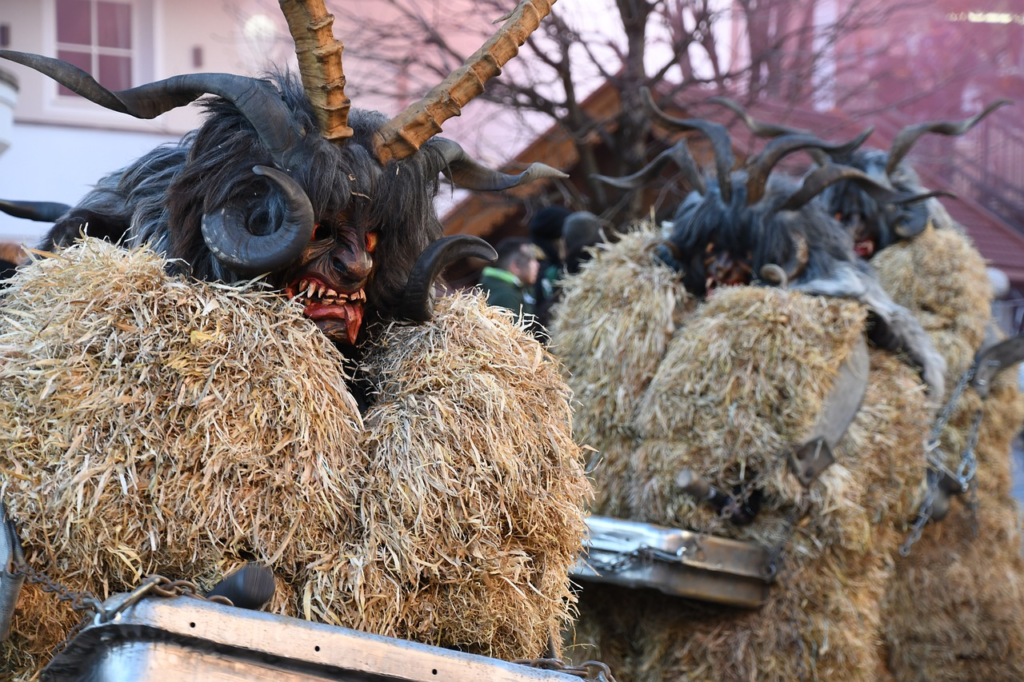
An Alpine goddess who appears during the Twelve Days of Christmas. In the Tyrol she is pictured as a wrinkled little old woman in tattered clothes. The masked Perchten in the photo above, andytheir Perchtenlauf parades, are named for her.
Perchta is Holda’s southern cousin or equivalent, as they both share and appear during the Twelve Days of Christmas.
Perctha is a Goddess of some kind
But I know nothing of her mind.
So I’ll leave her to her wintry rule;
Don’t give the Gods too overmuch fuel.
6. Belsnickel
Handles both the treats and the…opposite. He wears torn, tattered, and dirty clothes, and he carries a switch in his hand with which to beat naughty children, but also pockets full of cakes, candies, and nuts for good children.
Wikipedia, “Belsnickel”mes with Belsnickel
All I want for Christmas is this (I am not fickle)
What I really need is
another rhyme for “Belsnickel”.
He made it to America with German immigrants and still turns up in Pennsylvania Dutch country.
7. Knecht Ruprecht and Père Fouettard
St. Nicholas has a whole staff of helpers who do the frightening for him. In Germany, Knecht Ruprecht. In France and Belgium, Père Fouettard, “Father Whipper.”
These characters act as a foil to the benevolent Christmas gift-bringer, threatening to thrash or abduct disobedient children.
I’m sorry. They were too scary for me to write much about.
8. The Mari Lwyd
A Welsh custom, and a very strange one: a horse’s skull on a pole, carried door to door at Christmas.
The tradition entails the use of an eponymous hobby horse which is made from a horse’s skull mounted on a pole and carried by an individual hidden under a sheet.
The Mari Lyd, with skulls
Just want some supper inside their hulls.
Dinner to those who sing the best;
And we don’t know what happens to the rest.…oh, Krampus?
The skull and its team sing at your door, you sing back, and if they win the singing contest they get in and get fed. It is the only home invasion we know of that runs on rhyming.
9. The Wild Hunt
Not strictly a Christmas monster, but in Sweden people were warned to carry bread and steel when walking to church during Yule, in case they met the rider and his dogs.
Seeing the Wild Hunt was thought to forebode some catastrophe such as war or plague, or at best the death of the one who witnessed it.
The Wild Hunt will give pursuit
If you’ve a bow,
Don’t shoot;If you run slowly,
find somewhere to hide
It’s over your soul they quickly will ride.
“At best.” Folklore does not mess around.
10. Santa Claus, according to Jeff
The American Santa was a cheerful elf from the start. In the 1823 poem, “He was chubby and plump, a right jolly old elf.” Jeff’s Santa, in On A Pleasant Holiday Note, We’re All Doomed, is something else:
Yes, that’s right, it’s me, Santa, the only Eldrich Horror who really DIGS human culture!
Jeff Mach, On A Pleasant Holiday Note, We’re All Doomed
It ends on a note you will not find on a greeting card:
Because it is always Christmas.
And Christmas is always The End.Jeff Mach
Honorable mentions: the snowmen
Folklore has not caught up with snowmen yet. Jeff has. On Frosty:
Frosty the Snowman had a jolly, happy soul. It was delicious and tasted slightly like peppermint.
Jeff Mach on X (@darklordjournal), December 26, 2019
And from a winter piece he has not finished yet, a list of seasonal joys that takes a turn:
Winter Cometh,
snowballs,
hot cocoa,
crackling fires,
warming tales,
armies of undead Snowmen who have decided to unmake the World.Jeff Mach, “Winter Cometh” (unpublished draft)
Christmas monsters FAQ
What is the scariest Christmas monster?
Grýla, who cooks children, has a strong claim. The Wild Hunt, which kills you for looking at it, has a stronger one. Krampus is the most famous, mostly thanks to the parades and the movies.
Why are there so many monsters at Christmas?
Midwinter is the darkest, coldest time of year, and long winter nights are good for stories. Many of these figures also had a job: keeping children in line before the holidays. A good scare was cheaper than a present.
What is the Christmas cat that eats people?
That is the Yule Cat, Jólakötturinn, from Iceland. It eats people who did not get new clothes before Christmas Eve, or in gentler versions just their dinner.
When do the Christmas monsters come out?
Krampus comes on December 5. The Yule Lads arrive one at a time over the thirteen nights before Christmas. Perchta belongs to the Twelve Days of Christmas, which run into January.
More dark holiday reading: Present Arms, a poem about Krampus and Kringle, As Winter Comes, And The Bogeymen Shyly Leave Their Closets, and My 7 Favorite Things About Yuletide.
Featured image: jody_marx via Pixabay