Krampus is a horned, hairy, goat-footed figure from Alpine folklore who walks the streets with St. Nicholas in early December. Nicholas brings the good children presents. Krampus takes care of the others. His big night is Krampusnacht, December 5, the eve of St. Nicholas Day.
In this tradition, Saint Nicholas rewards well-behaved children with small gifts, while Krampus punishes badly behaved ones with birch rods.
We are on Krampus’s side here, more or less. As Jeff once put it:
My dearest Villains:
A Merry Krampus to all, and to all a good night, except for the Vampires, who are just waking up now.
Jeff Mach on X (@darklordjournal), December 26, 2019
What does Krampus look like?
Every town and every carver does him a little differently, but the basic Krampus is easy to spot:
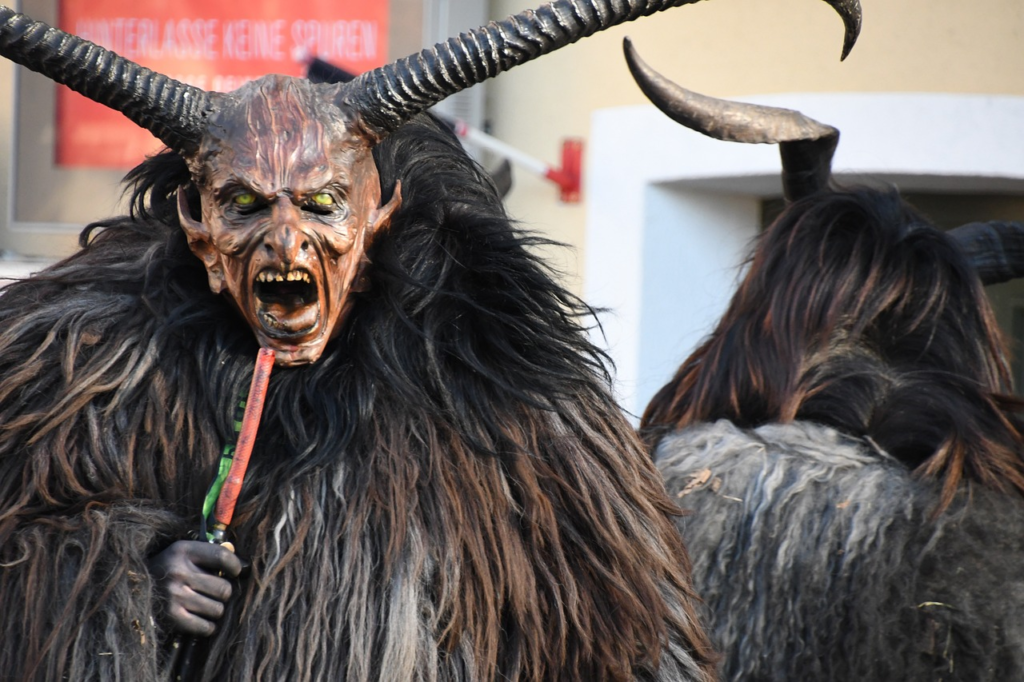
He is hairy, horned, usually brown or black, and has one foot with the cloven hooves of a goat. His long, pointed tongue lolls out, and he has fangs.
He also carries chains, bells and a bundle of birch switches, and sometimes a sack or basket on his back for carrying off the worst-behaved children. In Bavaria, the revival of the tradition has brought back hand-carved wooden masks.
What is Krampusnacht?
Krampusnacht means “Krampus Night.” It falls on December 5, the night before the Feast of St. Nicholas on December 6.
On the preceding evening of 5 December, Krampus Night or Krampusnacht, the wicked hairy devil appears on the streets. Sometimes accompanying St. Nicholas and sometimes on his own, Krampus visits homes and businesses.
The division of labor is simple. In the same article: “Nicholas dispenses gifts, while Krampus supplies coal and the birch rods.”
Where does Krampus come from?
Nobody is quite sure, and it is a livelier argument than you would think.
The origin of the figure is unclear; some folklorists and anthropologists have postulated that it may have pre-Christian origins, although historians generally consider this unlikely, as it is not attested until the 16th century.
The anthropologist John J. Honigmann, who studied a small town in Styria in the 1970s, found that the locals had their own theory:
They believe Krampus derives from a pagan supernatural who was assimilated to the Christian devil.
What is a Krampus run?
A Krampuslauf, or Krampus run, is a parade of people in full Krampus costume, with masks, horns, fur and bells. According to Wikipedia, “some young men dressed as Krampus attempt to scare the audience with their antics.” The older Perchtenlauf processions, with their own masked spirits, are often counted as the ancestors of the modern runs.
Was Krampus ever banned?
More than once. He was prohibited in Austria in the 1930s, and after the war the government tried a softer approach:
In the 1950s, the Government of Austria distributed pamphlets titled “Krampus Is an Evil Man” for fear that encounters with Krampus might damage children’s mental health.
It did not work. Krampus came back bigger, and these days he turns up in movies, TV shows and video games all over the world.
Krampus and Kringle: a Dark Lord’s Krampus poem
Jeff wrote a holiday poem about the two of them, St. Nicholas and his horned partner, and what each one is actually teaching. It opens like this:
Krampus and Kringle, two peas in a pod
One spares the child, one spoils the rod
One some kind of demon or God,
the other unclassifiable.Jeff Mach, Present Arms
It ends up somewhere you might not expect for a poem with a whip-carrying imp in it:
So Krampus and Kringle have brought us, this season
Not dualism, nihilism, pessimism, or maddened unreason
But a simple joined hope (that bitterest treason):
Stop fearing, and get on with doing.Jeff Mach, Present Arms
Kringle might bring toys. But know this in your bone:
You’re better off making some toys of your own.
And if you’ve a warrior’s heart, Krampus leaves you alone
In short: Be hard to control.Jeff Mach, Present Arms
The full poem is Present Arms.
Krampus FAQ
When is Krampusnacht?
December 5, the evening before St. Nicholas Day on December 6. That is the night Krampus traditionally comes out, and Krampus runs are held around it.
Is Krampus the devil?
He is often drawn as a devil, with horns, a tail and chains, and the chains are said to show the devil bound by the Church. But he works for St. Nicholas, not against him. Think of him as the saint’s enforcer.
Is Krampus evil?
The Austrian government thought so in the 1950s. In the folklore he only goes after naughty children, which makes him strict rather than evil. Whether that is better is between you and your conscience.
What do you give a Krampus?
A drink, apparently. Wikipedia notes that “it is customary to offer a Krampus schnapps, a strong distilled fruit brandy.” It may not save you, but it can’t hurt.
How is Krampus different from Santa Claus?
Santa, in the American version, handles both lists himself. The 1823 poem that shaped him makes a point of how harmless he is:
A wink of his eye and a twist of his head
Soon gave me to know I had nothing to dread.“Account of a Visit from St. Nicholas,” Troy Sentinel, December 23, 1823 (Wikisource)
Krampus never made anyone that promise. Jeff’s own childhood memory of the season, from My 7 Favorite Things About Yuletide, has both of them in it:
who among us does not have fond memories of young persons going from house to house, promising pleasantries from Santa Claus or malfortune from Krampus if people did not ‘give up’ their spare sugarplums?
Jeff Mach, My 7 Favorite Things About Yuletide
More dark holiday reading: On A Pleasant Holiday Note, We’re All Doomed, in which Santa turns out to be an eldritch horror, and Winter Solstice 2020.
Featured image: jody_marx via Pixabay